


At the Edge of What Comes Next, Reflections on a Difficult Year, and Why Businessworthy Leadership Matters Even More in 2026
2025 has been an unsettling year for the world, and a demanding one for the Business for Peace Foundation. Global tensions have deepened rather than eased. Armed conflicts are expanding. Trust in systems, institutions, and leadership continues to erode. Economic uncertainty has fed social division, and the idea that business can operate independently from these conditions has grown increasingly untenable.
Against this backdrop, our work has not been about broad commentary, but about leadership, specifically the kind that is required when the systems that enabled past prosperity are now under strain, and the responsibility business leaders hold in shaping outcomes rather than absorbing them.
This year, we continued to highlight businessworthy leadership that builds rather than fragments. Our reflection on Stef Wertheimer and Adnan Kassar reminded us that enterprise can bridge divides rather than entrench them. Our memorial to Roberto Servitje Sendra reaffirmed that business can be guided by values, humility, and service to society. We also confronted difficult realities directly. Our dialogue with Nobel Peace Prize laureate Dr Denis Mukwege explored business and human rights in fragile environments, not as theory but as lived consequence. Few discussions this year felt more urgent.
Alongside this, we have worked more closely with academics than ever before, developing a collaborative network around the field of business and peace. Their work has helped strengthen the intellectual grounding of businessworthiness. This included Why Global Tensions Urge Businesses to Adopt Mindful, Peace-Oriented Leadership, by Mark van Dorp, Lara Tcholakian and Ezra de Korte, which examined the pressures reshaping the leadership environment. It included Timothy L. Fort’s reflections on long-term responsibility and agency. And it included Crisis: A Global Case Primer, authored by scholars John Katsos and Jason Miklian collaborating with us, whose case-based work shows how instability unfolds and how leaders can navigate complexity without abandoning principle. These contributions were further reinforced by Jason Miklian’s writing on courage as currency, arguing that neutrality is no longer a risk-free option in global business.
All of this work, whether through dialogue, writing, convening, or research, has taken place during a year that has required difficult organisational decisions. Financial pressure has grown significantly. The situation has forced us to reduce staffing levels across the organisation, including senior roles. Beginning in 2026, much of our activity will continue on a temporary voluntary basis while we restructure and review what is financially sustainable. These steps reflect necessity, not preference, and they underline the urgency of what comes next.
Looking to 2026
If 2025 has clarified anything, it is that businessworthiness is not aspirational. It is necessary. Neutrality is no longer neutral. Responsibility cannot be outsourced. The future stability of markets, institutions, and societies depends on leadership that understands value creation as inseparable from peace and trust. Business for Peace enters 2026 with determination and a clear sense of purpose. We will continue to convene, challenge, and contribute to the ideas and practices that shape responsible business leadership, not through slogans but through work that insists leadership must be worthy of its influence.
Yet we are equally clear-eyed about the reality before us. The type of structural and normative work that questions existing business models and advances new ones is not easy to fund. Many organisations working at this intersection are under strain, and we are not immune to that pressure. The continuation and reach of our work is now directly tied to securing new financial support.
To maintain value that is independent, rigorous, and constructive, we will need partners who recognise that peace, trust, and long-term prosperity are inseparable. We invite funders, institutions, and individuals who share this belief to engage with us and help ensure this work not only continues, but strengthens. Without new support, the reach of our work will necessarily shrink, just as the need for it grows. With sustained backing, we can continue to mobilise a global community committed to redefining the role of business in society.
We are deeply grateful to everyone who has stood with us this year: our partners, supporters, Honourees, collaborators, and readers. Your commitment is what allows this work to move forward, even in difficult periods. With that support, we look ahead to 2026 with resolve, humility, and purpose, and we extend our best wishes for a safe and peaceful year ahead.
We welcome anyone who believes in this work to join us. The need could not be clearer. The moment demands it.
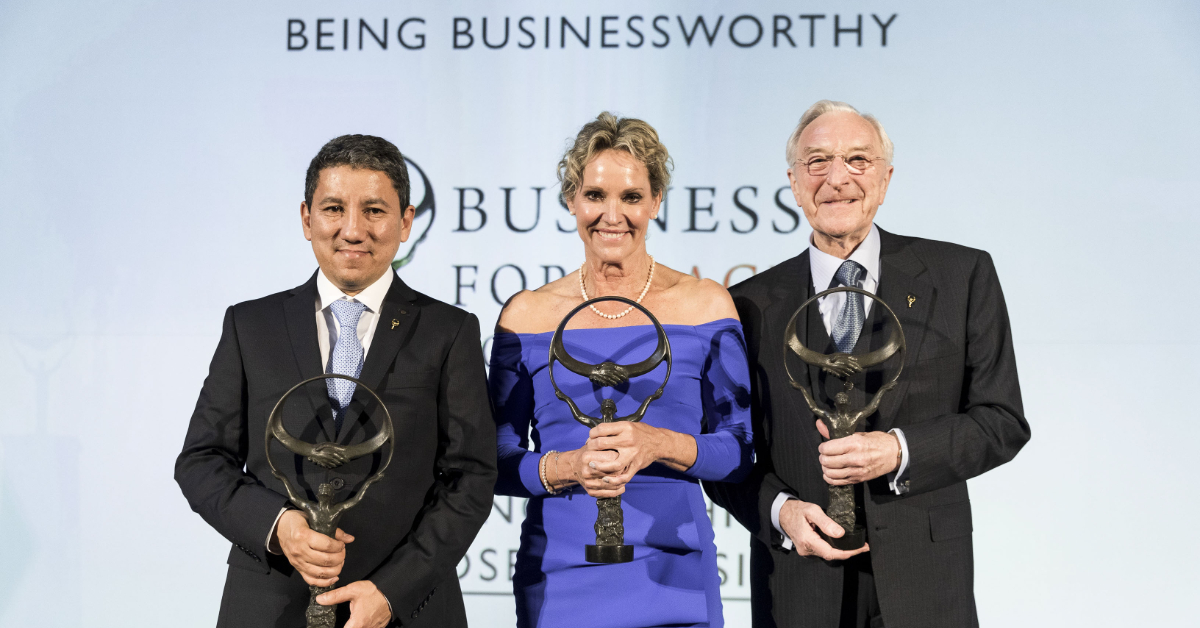
From left to right: 2018 Oslo Business for Peace Award Honourees Edgar Montenegro, Lori Blaker and Sir Martin Naughton